Friday, 6 January 2023

Birding Aldcliffe Returns!


Regular visitors to Birding Aldcliffe will have doubtless noticed that new posts to the site are somewhat rarer than ivory-billed woodpecker these days. I can only apologise for this; updates were once extremely regular… but that was when I, presumably, had a bit more time on my hands.

When I first started this blog (March 24, 2008) the idea was to highlight the Aldcliffe area as a key birdwatching site in North Lancashire. This was something a few of us already knew of course, and I’d already been birding there for 20 years at that point, but it often frustrated me that there would be days on end, especially during peak periods of potential activity, when no birders were visiting at all. I really wanted to share my passion for the Aldcliffe Marsh / Freeman’s Wood area and hopefully encourage more coverage from local birdwatchers.  

I first visited the area as a young lad in the late 1970s but it wasn’t until I returned to Lancaster after being away at college in the late 80s that I started birdwatching there regularly. At that time, I would venture onto the saltmarshes and wander along the old disused railway line (now the cycle path) with a couple of birding friends, Adrian ‘Ziggy’ Dawson and Greg Potter, both then students at St Martin’s College.

Looking through my old notebooks from that time, it was clear that I was going to my ‘local patch’ as often as I could (interspersed with frequent visits to RSPB Leighton Moss and further afield) and it’s also clear from these tatty old memoirs that there were a lot more birds around than there are today. There were also far fewer people and I would often only see the same handful of local dog walkers and occasional wildfowlers (Morecambe Bay Wildfowl Association own and manage Aldcliffe Marsh) from one visit to the next.

Changes in habitat, infrastructure, grazing regimes and livestock levels have all contrived to change the overall landscape while the notable increase in people, dogs, cycles and such have also impacted on wildlife here in recent decades.

Not all change has been negative - improvements including the creation and management of the Wildfowlers’ Pools along with the much larger Freemans’ Pools (a ‘borrow’ pool that came into being after sea-defence bunds were built to prevent tidal flooding and now managed by Lancashire Wildlife Trust) have been fantastic.

But, we have lost corn bunting (last bred in arable fields in 1990 and swiftly vanished when the fields were turned into a biodiversity vacuum, ie grazing land) and grey partridge is almost certainly extinct in the area now.  Bewick’s swans were once an annual highlight with significant numbers to be expected on the marsh every winter, but sadly no more.   

There have of course also been gains. The expansion in the range of little egrets nationally means this bird is now a common sight all along the River Lune, with great white egrets now following in their footsteps. Little ringed plover are annual summer visitors, as are reed warblers (both relatively recent colonisers). Stock dove and rook were both once scarce on the patch but are now regular year-round.

Despite the seemingly endless stream of dogs, walkers and cyclists that are now a daily feature of the area, there are still birds to be found here. It can still offer great spring birding when scores of migrants pass through in the right conditions. It is still a stronghold for breeding lesser whitethroats, wintering green sandpiper and good numbers of migrating geese with scarcer species such as bean and white-fronted expected most years.

The obvious lack of postings over the last couple of years isn’t necessarily an indication of fewer visits; I still get out there regularly and there are certainly more birdwatchers visiting the site today than when I first started birding there. While I was away in Canada for a few years (where I also had a blog: Brit Birder in BC) Dan Heywood, Steve Wallis et al, kindly kept this blog alive with frequent updates and we certainly get far more records from the Aldcliffe area these days thanks to the increase in coverage.

Moving forward I will endeavour to post at least once a month, covering recent highlights. Hopefully this will inspire more binocular-wielding folk to explore this fabulous area and who knows, you might be the one to discover the next new patch bird!

Coming soon... 2022 Highlights From The Patch.


Monday, 11 April 2022

Spring Things...

I've managed a few trips down to Aldcliffe for a spot of birding in recent days; spring time, despite the rather crummy wind direction of late, always lures me out in search of birds passing through. Despite the unhelpful conditions, it's been mostly dry (bar the odd hail shower) and some determined migrants have made it through. 

Personal highlights this week have included a fine drake garganey on Freeman's Pools on Friday, a wheatear by The Flood on Tuesday and both swallow and willow warblers today (Monday 11). 

Dan H had his first tree pipit of the season earlier in the week and an osprey flew over Fairfield just after noon today. 

Up to 3 little ringed plovers and a green sandpiper have been regular on both the Wildfowlers' Pools and the Flood. We could do with a bit of rain to keep the Flood a little wet and muddy to attract waders and wagtails in the next couple of weeks...   


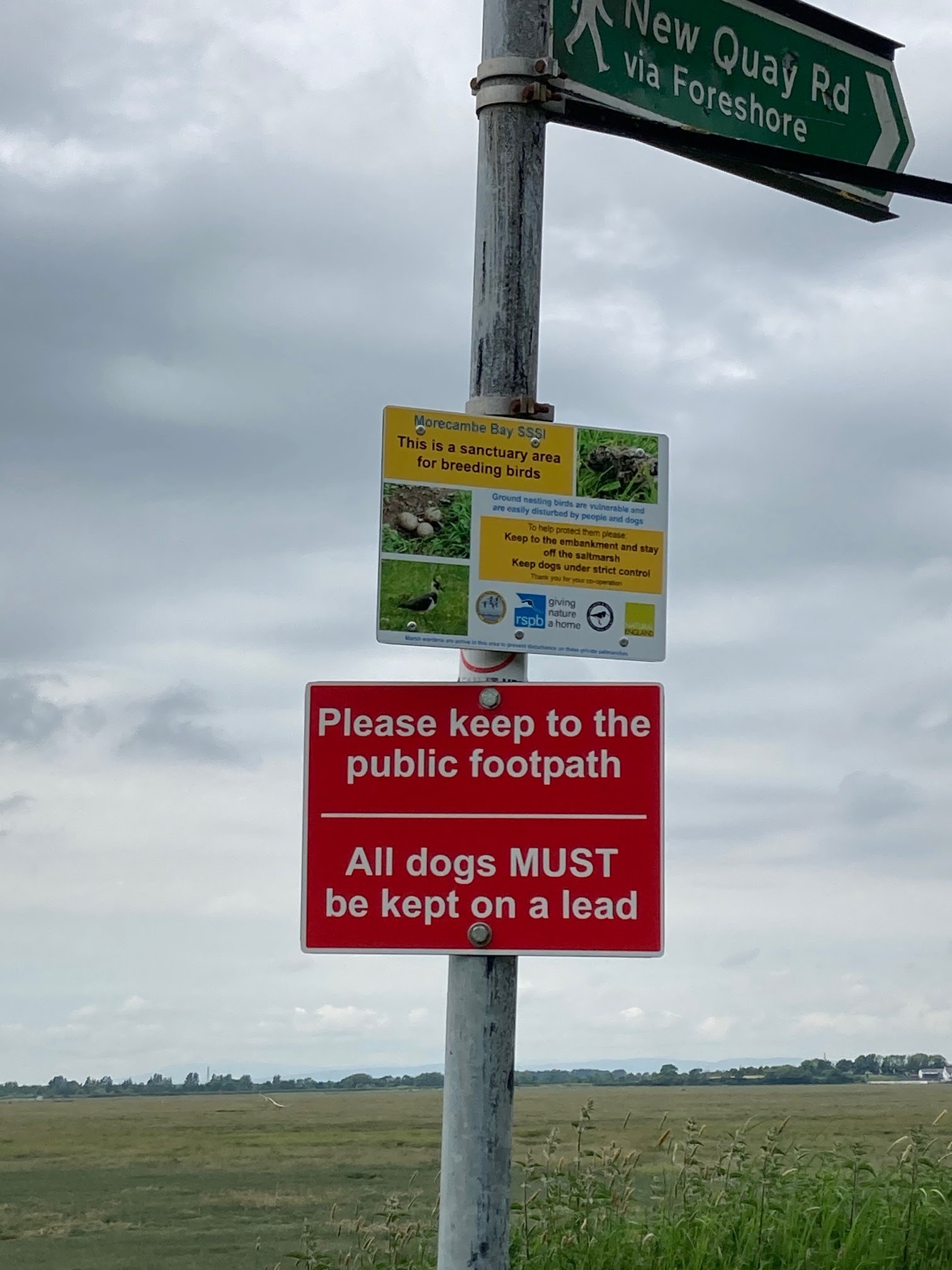
As ever, the Easter holidays has seen an increase in the number of people with off-lead dogs wandering around all over the saltmarsh, having first walked past all the signs explicitly asking them not to. It's really no wonder that the number of birds seen in these areas of marsh have diminished significantly in recent years. Constant disturbance simply prevents birds from roosting, feeding and nesting.     

(Pic of drake garganey not taken at Aldcliffe but recently at Cockersands)       

Monday, 4 April 2022

2022 Update!

Flippin' heck. It's been a while. 

As ever, I have had lots of good intentions to update this page from time to time but alas I simply haven't got round to it. So, here we are almost two years since the last post. Quite a lot has happened in that time to be fair, both in the wider world and indeed at Aldcliffe. And, while many of the bigger issues have been somewhat consuming, we shall try not to focus on those here and instead direct our interests to the matter of birding in and around the Aldcliffe area. 

Since our last blog post, there have been a one or two notable developments in the area. 
The Lancaster & District Birdwatching Society (LDBWS) have installed an excellent feeding station by Pony Wood at Fairfield. As a result we have seen a wide variety of species using this resource including good numbers of reed buntings and bramblings - much to the delight of local birdwatchers and the local community in general. 

Also, some extensive drainage work has been done in an effort to reduce flooding in the fields bordering Aldcliffe Hall Lane and the cycle track. This has the potential to reduce this area's appeal to birds (particularly passage waders and wagtails etc) but the actual outcomes have yet to be seen. 

Meanwhile the overall condition of the Aldcliffe landscape continues to be generally poor for wildlife and the stretch from Freeman's Wood to Stodday is increasingly uninviting to many birds. A notable increase in the number of people using the cycle-track and the spill-over disturbance onto the marsh and into the fields, especially by significant numbers of people with off-lead dogs, appears to be having quite an impact. Despite lots of signage having placed at the entry points, many dog-owners appear to think that it applies to other pet owners only.


The Wildfowlers' Pools still attract plenty of birds seasonally as do Freeman's Pools, so it's not all bad.

When I started this blog, the primary purpose was to try to highlight the area's potential and hopefully encourage more birdwatchers to visit - after all I had been birding here since the 1980s and knew how good it could be! Thankfully, more people do birdwatch here now than ever and thanks to this increase and regular ongoing coverage by a small but dedicated band of local patchers we have a far better understanding of the area and its value to breeding and wintering birds as well as off-passage migrants. 

So, given that it's spring (not that it feels like it out there today) let's kick off with some seasonal news...

Spring migrants so far include: 

Chiffchaff (plenty singing around the entire area for some time now) 

Blackcap: (small numbers singing in and around Freeman's Wood)

Little ringed plover (at least 3 birds on The Flood and Wildfowlers' Pools)

Ruff (1 at Wildfowlers' Pools 27-28 March)

(No one had any sand martins here yet???)

Other odds and sods in recent weeks include red kite, tundra bean goose, white-fronted goose, barn owl, Mediterranean gull, ringed plover, black-tailed godwit, etc. 

It is my intention to maintain some sort of updates here moving forward, but I've had those sort of intentions before. Let's see how we get on...          

Jon         

Tuesday, 12 May 2020

More Migrants on the Move

With no further sightings of Saturday's RB shrike and the notable change in weather (from positively Mediterranean to classic Northern European) one would expect things to have quietened down on the patch in recent days.
However, a couple of very welcome late migrants were added to the Aldcliffe yearlist with an active female redstart by Freeman's Pools yesterday (Monday) and a couple of whinchats there this morning.

Female whinchat (from archive, J Carter)
I had gone out this morning with the express intention of finding a whinchat, so I was pleased when I finally clapped eyes on them in an area where they often turn up.
That's the thing about local patch birding; over the years one builds up a picture of a site and often the same areas attract the same species when passing through. By checking certain favoured spots at certain times of year, one increases the chances of finding specific birds.
When I first noticed this morning's whinchats they were feeding in much the same area but one of the birds seemed to take offence to the other and chased it off.

Other birds of note included a pair of great crested grebes on the pools - prospective breeders?

Jon

Monday, 11 May 2020

Bike / Hike Shrike

One of the concerns of local patch birding is how to treat news if one finds a rare bird? Can we manage parking and access, how far might people wish to travel in order to see a scarce visitor and how many birdwatchers might descend on this relatively quiet spot?

Male red-backed shrike (J Carter)
Of course, in lockdown these questions are to some extent moot - we would not wish to encourage anyone to get in a car in order to twitch a regional or national rarity. So while the small band of Aldcliffe patch birders have continued to search for noteworthy birds we have been, uncharacteristically, hoping not to discover anything that might draw the crowds.

However, when news broke on Saturday afternoon that a male red-backed shrike had been discovered along the Dawson Bank hedgerow, a small gaggle of West Lancaster birders suddenly found the need to take their daily exercise (as per government guidelines, after all).

Personally, I've spent time on the patch pretty much every day since I was furloughed but I'd given Saturday a miss due to the glorious weather and the likely hordes of walkers, cyclists etc, as a result of the lack of coherent messaging about staying at home... I believe the phrase may be Sod's law!

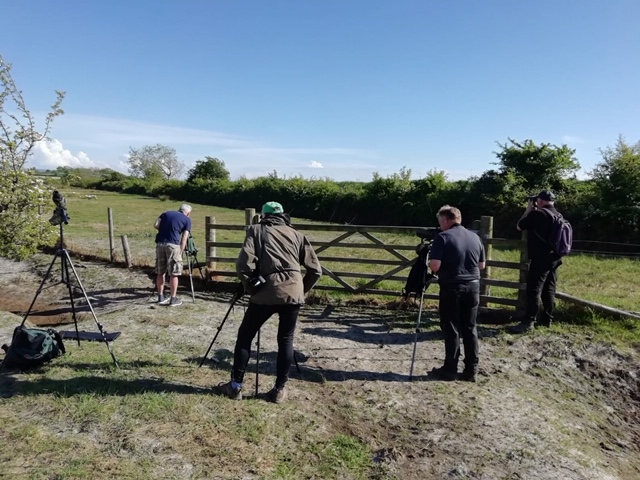
Local birders observing social distancing (P Crooks)
News reached the grapevine just before 4pm (huge thanks to finder Joe Murphy) and despite my immediate reservations about dropping everything (decorating, as it happens) I soon found myself leaping on my bike and heading towards the patch, which is literally just minutes from home. Despite the bird having disappeared from view, and news of its last whereabouts being vague, less than half an hour after deciding to leave the house I was stood watching this most dazzling of continental overshoots. Within an hour of news breaking, most of the local patchers were on site enjoying good views of the bird.

Red-backed shrike is a long-overdue first the Aldcliffe area and it represents the third species of shrike to be seen here to my knowledge.
A great grey shrike spent some time in Freeman's Wood back in December 1991 and a stunning woodchat shrike was in almost the same area as the red-backed (and remarkably close in date) on 8/9 May 2014. So, which next: Lesser grey? Steppe grey? Brown? Masked? Watch this space!  

RB shrike brings the known Aldcliffe list to 204 and my personal patch list to 201.  

Jon    

Friday, 8 May 2020

May Magic

As April gave way to May the optimistic amongst us were out in search of more incoming migrants and while there were few surprises, we did at least see the continued arrival of commoner species.

Newly arrived swallow stops for a brief rest at the pools (J Carter)

A short trek anywhere along the cycle path between Freeman's Wood and Stodday is sure to be accompanied by a soundtrack provided by multiple warblers. Blackcaps, chiffchaffs, whitethroats, lesser whitethroats and sedge and willow warblers can all be heard with ease, blasting out their territorial rights. Reed warblers too are back in their usual nesting sites. Overhead swallows, house martins and swifts regularly sweep through while on the saltmarsh a few late wheatears, probably bound for Greenland, can still be found.
The majority of lingering white wagtails moved on last week with just a handful remaining into May. 

Yep, I'd be knackered too if I'd flown from South Africa (J Carter)

On the ponds, as the water levels continue to drop due to the mostly rain free conditions of late, the number of birds has similarly dropped. The local breeding species remain alongside a few non-breeders. At least a dozen gadwall are hanging around along with a pair of teal. A lone drake wigeon looks set to spend the summer with us.
This morning (Friday 8) a single pink-footed goose was at the Wildfowlers' Pools - a couple of days ago Dan came across an unseasonal (and doubtless un-wild) barnacle goose. I failed to catch up with this May mega and had to do with the sight of a rather attractive, if incongruous, black swan on the Lune this morning in order to fill my quota of well-dodgy-wildfowl.   
Talking of pointless web-footed birds, the first Canada goose goslings emerged this week while multiple mallard broods of various sizes can be spotted by anyone bored enough to look.
A Freeman's Pools the garrullous black-headed gull colony continues to grow - it will interesting to see how many young they get off this year.

Roe deer by Freeman's Pools
The doomed lapwings in the fields have continued to get repeatedly clobbered by the need to grow maize for indoor cattle. There have now been three separate assaults on these fields ensuring that any second or even third nesting attempts have been rendered pointless. The handful of birds sat in the fields now may yet have a further visit by large agricultural plant to contend with. Let's the solitary nesting lapwing by the pools has some success.

On a less depressing note, other notable birds to have been seen around the Aldcliffe patch in recent days include: whimbrel, common sandpiper, common tern, eider and osprey.

With the forecast set to change significantly it will interesting to see how this affects the local birds and other wildlife in the coming days...

Jon


Monday, 27 April 2020

Dan Gets Wood Again

After the relative thrills of having a spring wood sandpiper on the local patch, Dan got wood for a second time in two days when he found a singing wood warbler near the FAUNA nature reserve on Sunday morning.

Wood warbler record shot by Dan H
Yet another rapidly declining species nationally, wood warblers are not easy to find anywhere in North Lancashire these days and they are extremely scarce off-passage migrants. Only a handful have been recorded on the Aldcliffe patch by local birders in recent years with the last at Stodday on 25 April 2016 (almost four years to the day; also found by Dan). Prior to that, the last sighting I'm aware of was in early May 2011. So with that context, it is quite easy to see why Dan's Sunday discovery was exceedingly notable!

I was unable to get out yesterday but thankfully (if somewhat surprisingly) the warbler stayed around overnight and was still in the area this morning. Dan heard it in Admiralty Wood early on and I caught up with it along the tree-lined Aldcliffe Hall Drive where it was singing intermittently and eventually showed well.

Cetti's warbler by Dan H
On the subject of warblers, Dan's persistence and dedication paid off once more when he located a Cetti's warbler between Lunecliffe Road and the canal. Again, this is an uncommon species locally but unlike wood warbler, this colonising warbler is increasing across the UK. Once regarded as a major rarity confined to the south coast this skulking but vociferous bird can be found at nearby hotspots such as RSPB Leighton Moss at Silverdale and Middleton NR near Heysham.
With just one previous record on the patch (October 2015) Cetti's is long-overdue as a breeding bird on this side of the Lune. Let's hope that this signifies the arrival of the species as a regular bird to the patch!

Jon


Saturday, 25 April 2020

Wood In The Hood

A great find by Dan on the Wildfowlers' Pools this morning - a dazzling, spangled wood sandpiper.

Although just about annual on the Aldcliffe patch, these scarce waders are more likely to be found in late summer when failed / post-breeding or juvenile birds are heading south. Spring records are far less common and it's great to see such a pristine adult wood sand on the pools!

Other waders at the pools included ringed plover, little ringed plover, dunlin, common sandpiper, black-tailed godwit, lapwing and redshank.

Nearby a small flock of 7 swifts were feeding high over the quay.


Photos by Dan Heywood


Thursday, 23 April 2020

Seeing Red (Kite)

Yellow wagtail (Barrie Cooper)
Spring continues to bring us sunshine, and easterlies with no rain. As a consequence, we have seen relatively little in the way of off-passage migration but the regular stuff returning to territory has certainly been noticeable. And in many cases, quite early too.

Of course the two species totally defying the 'no off-passage stuff' comments are the wagtails, which have continued to drop in in varying numbers over recent days. The one-day peak count of flava wags currently stands at six birds; astonishing anywhere in North Lancashire in spring these days. Among the classic British flavissima yellow wagtails we have also had a nominate flava blue-headed male and a smart 'Channel' male (the latter being hybrid blue-headed x yellow).

'Channel' wagtail (Dan Heywood)
Meanwhile, the maximum estimations for white wagtails has been around the 60 mark - equally remarkable!

Of the aforementioned regular and expected arrivals, the past couple of days has seen a marked increase in warblers around the Aldcliffe patch. As one travels along the cycle track between Freeman's Wood and Aldcliffe Hall Lane the cacophonous sound of various species' songs is all-but impossible to ignore. Joining the chiffchaffs, willow warblers and blackcaps which have been present for a couple of weeks or so, there are now lesser whitethroats, common whitethroats and sedge warblers adding to the aural spectacle. Of course added to these newcomers' vocal contributions are the songs of the 'resident' goldfinches, wrens, song thrushes,  blackbirds and robins, amongst others.

Ringed plover (Jon Carter)
As the water levels continue to drop, the diversity of birds on the Wildfowlers' Pools is equally diminishing. Just a hand full of black-tailed godwits remain along wth a few redshank and lapwing plus single common sandpiperdunlin and common ringed plover in recent days. At least two pairs of little ringed plover remain and avocets continue to drop in from time to time, adding a splash of the exotic.

Wheatear (Dan Heywood)
Other birds of note recorded by local birdwatchers in recent days include swiftwhinchat, grasshopper warbler, tree pipit
and whimbrel.

The highlight of the week so far was the appearance of a smart adult red kite that materialised over Aldcliffe Marsh on Tuesday, attracting the attention of the local gulls and as a result, me!
The bird was clearly following the Lune and heading inland and was last seen as it veered over the old Salt Ayre tip and headed off in the direction of Morecambe. Fortunately I was able to alert a couple of other Aldcliffe regulars who were able to spot the elegant raptor before it vanished from local patch airspace. This is only the second red kite I've seen here in around thirty years of birding at Aldcliffe and as far as I am aware only the third ever record for this site.

Jon

Saturday, 18 April 2020

Flava of the month

Yellow wagtail (Dan Heywood)
Despite the lack of forecast (then un-forecast) rain this morning there was still enough to entertain the early bird. I had rather hoped to be tripping over freshly dropped migrants but with a steady easterly wind and not a hint of water in the air this didn't seem too realistic a prospect as I cycled my way onto the patch.

First stop at Freeman's Pools revealed little to get excited about - the gang of prospective nesting black-headed gulls were loafing on the island as per usual. A couple of tufted duck, a lone lingering goldeneye and a pair of little grebes were the only things on the water other than the odd coot and moorhen. A small number of sand martins and a swallow were hawking over the pools.
The cycle track was soundtracked by multiple species in fine song; blackcaps, chiffchaffs, willow warblers, robins, blackbirds, wren, dunnock and a song thrush. A family (?) group of 7 jays were making their way noisily along the track edge.

It was business as usual at the recently trashed maize fields - pairs of lapwing rebonding and preparing to nest once again. Of course, we know this to be futile as the fields will be ravaged once more in the next stage of the effort to grow animal fodder. In most years, one or two nests may get chicks off but the successful ones come mostly from the adjoining fields, owned and managed by the Wildfowlers Association.

Common sandpiper (Dan Heywood)
The water-levels at the aforementioned Wildfowlers' Pools continue to drop, revealing more fabulous mud. While the bulk of the ducks and waders have cleared off, leaving just a few teal, 4 wigeon, the odd gadwall and a small number of black-tailed godwits and redshanks, this wet sloppy vista is certainly attracting a few passing migrants.

Top of the list is yellow wagtail - once a frequent spring passage bird here but shockingly scarce in recent years (reflecting the worrying, wider decline of this once common summer visitor). At least one dazzling male and rather cryptic female were seen by the pools this morning, though their mobility made keeping up with their whereabouts entertaining!
Dan contacted me just after 8.30am to say he'd found a couple more males on the Flood; they certainly hadn't been there when I'd checked around 7.30am. This is turning out to be the best year for this species on the Aldcliffe patch for literally decades.
Associated with this mega-event is the presence of large numbers of white wagtails. Ordinarily this area sees steady numbers moving through, mostly in the teens, but this spring we have been virtually inundated! There were at least forty feeding around the pools and the flood today. Quite impressive.

Wheatear (Dan Heywood)
Also on the Wildfowlers' Pools were just 3 little ringed plover (there were 7 there yesterday) and the common sandpiper was still picking its way around the pool edges. Good numbers of sand martin, with a few house martins and swallows were moving through while small groups of meadow pipit could be seen feeding among the wagtails or passing overhead.

A sedge warbler continues to sing at Reedy Corner, where there are still a few tufted duck hanging on, while a couple of wheatears were in the general area (saltmarsh and fields). I only heard one lesser whitethroat this morning and, surprisingly, I have yet to see or hear a common whitethroat.

A redstart was reported from near the Wildfowlers' Pools yesterday. Other birds seen by regular Aldcliffe patch birders in the last last 2-3 days include whimbrel, ringed plover and a rather late fieldfare.

Jon (thanks to Dan for the photos)
    

Monday, 13 April 2020

Return of the Blog

Hello there!
Well, once again I find myself posting for the first time in ages and offering an apology of sorts...

The lack of updates doesn't necessarily reflect a lack of visits to the Aldcliffe patch on my part, more a reflection of my ability to be bothered to log in and write a post! I suppose with spending my working days at RSPB Leighton Moss, my free time spent on the patch is a little escape from the public face of birdwatching and a space where I can retract a little and call my own.
However with the extremely unusual change in circumstances that we're all going through (to varying degrees) it seems that perhaps now is the time once again to share my love of this area on my doorstep.
Of course living so close to my favourite birding spot, I can easily walk or cycle here while observing government guidelines around exercise, etc. The fact that I live within spitting distance is not merely some piece of luck - it was one of the key deciders when we bought the house.

Flooded fields (with garganey centre!)
So, it's spring! Migration is well under way and the patch has been delivering.
One of the things that has changed recently, and is certainly influencing the birding, is the breaching of the seawall along Dawson's Bank which occurred earlier in the year.
Thanks to the efforts of some 'terrier men' (i.e. those who like killing wild animals for fun) a while back, the bank was seemingly structurally weakened by these fine countryfolk digging out a fox den and doing naff all to repair the damage once they'd had their fun.  The wettest February on record coupled with massive tides resulted in some significant damage leaving the maize fields and those around the Wildfowlers' Pools inundated with seawater.

Black-tailed godwit
The positive result, from a birder's perspective, is that the area between the cycle track and saltmarsh has become a temporary lake and latterly a very tasty muddy wetland; highly attractive to birds. In the past few weeks this area has hosted huge numbers of black-tailed godwit, along with good numbers of redshank and plenty of wildfowl. The regular teal, wigeon, gadwall, goldeneye and tufted ducks have been joined by pintail, shoveler and even a spanking drake garganey which spent a few days wowing local birders.

One of the outcomes of the restrictions being placed upon people and how they access the outdoors has been the massive increase in those using the Freeman's Wood / Aldcliffe Marsh footpaths and cycle track. I have never seen it so busy. Even when out at first light, where I may ordinarily see two or three dog-walkers and the odd jogger in the course a couple of hours, now I will encounter 20+ people in an hour. And while such excellent local birdwatching sites as Leighton Moss are closed, more local birdwatchers are visiting the Aldcliffe area too.

Avocets at the Wildfowlers' Pools
It would seem that some joggers and cyclists appear to believe that lycra offers protective powers against Covid-19, and therefore there's no need to observe 2m distancing from others, which does make birdwatching in the area much less enjoyable I have to say. A constant stream of panting individuals along one metre wide paths isn't all that appealing right now and I for one am steering clear of some the spots I would usually check. But, I shall continue to make visits of sorts and post my sightings, and those of others, while doing my utmost to avoid the masses.

If you too live within walking distance of the area and decide to go birdwatching please do observe the guidelines and please pass on your sightings by commenting on this site, or posting on the LDBWS website.

Recent highlights include:
Garganey
White-fronted goose (Greenland)
Marsh harrier
Osprey
Avocets
Ruff
Little ringed plover
Yellow wagtail
20+ white wagtails
Tree pipit
Whinchat
Sedge warbler
plus good numbers of common migrants including: wheatears, sand martins, swallows, house martins, chiffchaffs, willow warblers, blackcaps,

Jon


Tuesday, 23 April 2019

Tasty Duck as Spring Rolls On

Regular visitors birding in the Aldcliffe area may have noticed that the maize fields have yet to be ploughed and seeded, so fingers crossed the lapwings might just get some chicks hatched again this year. That said, I haven't seen many pairs in there compared with previous years - I suppose that's what happens after several consecutive years of nest destruction; numbers go down. Worth noting too that the most northerly of the two maize fields has now been converted to grass production, thus reducing nesting habitat for lapwings. No wonder they, like many breeding waders reliant on quality farmland, are declining rapidly across the UK.

I did get word that a pair of grey partridge had been seen in the fields beyond Freeman's Pools - perhaps they're not quite extinct in the Aldcliffe area after all. However, one pair clinging on for dear life is hardly something to celebrate!

On a more positive note, little ringed plovers finally arrived (better late than never) with the first report from The Flood on April 3. They peaked at 7 on 13th and there were still 5 present yesterday (Easter Monday) but just 2 there this morning.

The main highlight from this morning was a cracking drake garganey on the Wildfowlers' Pools. other migrants were pretty thin on the ground, 3 wheatear on Aldcliffe Marsh and another one on The Flood being the only obvious passage birds. I was rather hoping for something of the whinchat / redstart variety (see Heysham Obs blog).
I only counted 3 each of lesser and common whitethroat in the two-and-half hours I was out though blackcaps were absolutely everywhere.
The sedge warbler I heard on Sunday had either moved on or was just keeping quiet.
Of course, there are lots of swallows, sand martins and house martins around now along with willow warblers and chiffchaffs too.

A few other recent sightings of interest from the Aldcliffe area include: osprey, marsh harrier, white wagtail and yellow wagtail

Please note there is an up-to-date Save Freeman's Wood Facebook group 

Jon


Monday, 1 April 2019

Scattering of Spring Migrants

A few highlights from a morning trawl today included: 

House Martin - my first of the year with with a few sand martins at Freeman's Pools
Sand martin - several passing through plus birds feeding at Freeman's pools. 
Wheatear - 11 (8 on tideline, 3 in fields)
Blackcap - 2 singing in Freeman's Wood 

Green sandpiper on Frog Pond
Black-tailed godwit c250 on The Flood & c300 on Wildfowlers' Pools 
Wildfowl included 4 goldeneye, 3 pink-footed geese, 3 shoveler, 4 tufted duck plus a fe gadwall and teal. 
Great White egret on Colloway Marsh 
Multiple chiffchaffs singing around the patch.

Sadly, no sign of any little ringed plover
Last year the first (late, thanks in part to the 'Beast from the East') arrival was on April 1. 
The Flood has no appealing muddy edges thanks to high water levels at the moment and although the Wildfowlers' Pools are crawling with waders it's presumably also too wet for LRPs. 

For context, recent years LRP arrival dates at Aldcliffe as follows - all March: 21st 2017, 18th 2016, 19th 2015 & 2014, 17th in 2013. 

Of note, I didn't find any evidence of breeding at Aldcliffe last year...

Jon

Sunday, 24 February 2019

Annual Aldcliffe goose fest

As to be expected in later winter / early spring, Aldcliffe saw an arrival of good numbers of pink-footed geese in mid-February. Peaking at around 3,000 birds (relatively low by some years standards) the flock included one or two other species of note.
So far, both subspecies of greater white-fronted goose have been seen - 3 Russian birds (1 adult and 2 juvs) were found by Dan Heywood (pic of adult by Dan) on the 10th, and a Greenland bird on the 19th while a fine tundra bean goose was discovered by Matt Jackson on the 18th. This latter scarcity had the decency to hang around for a few days and was seen by many local birders.

Of course there were also plenty of greylags and Canada geese around too.
Other birds of note in recent weeks include water pipit, up to two great white egrets, merlin, barn owl, black-tailed godwits and pintail.
Dan came across a yellowhammer - very much a rarity in North Lancashire these days - on the morning of 24th in the Fairfield stubble fields. The last Aldcliffe area record (I think) concerned a fly-over in the autumn of 2011!
If the decent weather continues we can hope for some early migrants in the next few days and weeks; first to appear are usually little ringed plover, sand martin, wheatear and chiffchaff. Last year's famously late spring saw many delayed arrivals, so fingers crossed this year gets off to a better start.
Jon   

Wednesday, 13 February 2019

Save Freeman's Wood

For decades, the area of mixed woodland and scrub (known locally as Freeman's Wood) to the south west of the Lune Industrial Estate off Willow Lane, Lancaster has been a well-used and popular space for local residents.

Children have built dens, dog walkers have exercised their pets and, for me and many other Lancastrians, it has been a great area to connect with nature.

It is a significant nesting site for an array of nationally declining woodland and garden birds, an important wintering site for long-distance migrants from the north and an essential stopping-off place for summer visitors freshly arrived from Africa and continental Europe.

Once again, this prime piece of wildlife habitat is under threat. An application to build 250 houses on the land has been submitted. Obviously, if this goes ahead we will not only lose the space for our own recreational use but it will also destroy a vital area of rare biodiversity within the city boundaries. 

Campaigners are asking for your help to save this invaluable local resource.

You can object to the proposal:
Visit www.lancaster.gov.uk/planning and place an objection online.

Write to Planning, PO Box 4, Lancaster Town Hall, LA1 1QR or email dcconsultation@lancaster.gov.uk

Quote the reference number 18/01520/OUT

There will be a public meeting at Hornets Function Room (off Willow Lane, behind the Spar shop) on Feb 26 at 7.30pm where the proposal will be discussed. 


Freeman's Wood as viewed from Marsh Point overlooking Freeman's Pools


Saturday, 1 September 2018

The Promise of Autumn

Well, that was a long time between posts wasn't it folks?
I have to say, despite my not posting anything on here since the beginning of April there's hardly been an outcry from my loyal readers... one or two mentions here and there just about covers it.
So, what's the reason for the lack of input on my part? I don't really know, to be honest. I've been birding around the Aldcliffe area as usual but I've been somewhat uninspired by my wanderings. The terrible weather in spring meant little in the way of passage migrants on the patch and the wonderful summer heatwave was admittedly good for many breeding birds though was dull as far as variety goes.
And here we are, about to embark on autumn - surely the most exciting of all seasons in the birders' calendar. But before we look at the potential joys of September, here are few notable records from the pat few months:
April 13 - marsh harrier
May 5 - very long overdue patch tick came in the form of a red kite (about bloody time!)
May 25 - marsh harrier & 2 ruff
June 25 - first post-breeding green sandpiper back in the area

Little ringed plovers eventually appeared but in lower numbers than in recent years and didn't breed anywhere on the patch.
Lapwings had a better year, thanks to the wet fields delaying ploughing. Several young fledged from the maize fields and a couple got off from the Wildfowlers' Pools.
Oystercatchers fledged at least one young and there were two broods of tufted ducks at Freeman's Pools.
short-eared owl was seen by a dog walker in early July - we occasionally get wandering post-breeders passing through in late summer but they never linger. It would be nice to get a wintering bird on the patch this year.

As autumn proceeds I expect things will start picking up a bit - yesterday I had a couple of flyover meadow pipits and a pair of wheatears on the saltmarsh, so things are looking up! Wader numbers have been pretty dire with just the lone green sandpiper commuting between the pools. A few more duck are dribbling in with 9 gadwall back on patch.  

Jon

Monday, 2 April 2018

Is it spring yet?

Welcome to the most uninspiring spring of all time. Which is quite fitting I suppose, given that this winter was possibly the dullest I can remember as far as birding around Aldcliffe is concerned.
The lack of posts here has been solely down to a lack of enthusiasm on my part - I've been out around the patch on plenty of occasions but the birds have barely differed from one visit to the next.

In summary:
There was loads of water, the pools were high and the cycle track was flooded for most of the season. Water levels have now dropped. Of note, the smaller rear pool at the Wildfowlers' Pools has been 'de-vegetated' and re-landscaped for the benefit of ducks but little else.  

Duck numbers were relatively unremarkable although we had a decent mix of species. Highlights have included double figure shovelers and up to five pintail throughout and a pair of pochard for a couple of days and a high count of 29 goldeneye in early March.
Goose numbers were disappointing on the whole with no real large peak of pinkfeet (fewer than 3000) and as such no attendant scarce species. 

Ringed plover
At least one jack snipe was present for most of the winter and up to four were at FAUNA.
Other wader records worth noting included occasional green sandpiper, multiple (up to 90) black-tailed godwits, an incredibly 400 or so dunlin on The Flood on March 5 along with 20 snipe and local patch scarcities knot (1) and ringed plover (3) by the Wildfowlers' Pools the same day.
Also in the area were around 100 golden plover. These unusual wader numbers came in the wake of the so-called 'Beast From The East' or as I like to call it, 'weather'. 

Peregrine, sparrowhawk, buzzard and kestrel have all been present here and there along with occasional sightings of a female merlin out on the marsh. 

Tideline passerines have been very thin on the ground with no finch flocks to speak of and no twite or redpoll (other than odd flyovers of the latter) as yet. A wandering group of c25-35 linnet have been in and out of the maize fields frequently.
One notable event on March 3 involved a flock of 32 skylarks; common enough here in small numbers but these days a grounded flock of that size is exceptional. The same day a single rock pipit was also seen nearby - both presumably pushed onto Aldcliffe Marsh by the high tide.
The first stonechat I clocked was a single bird on March 5 with a further three present on 12th.

Stonecat
Chiffchaff wave trickled in but given the state of the weather at the moment it's hardly surprising they've been slow to arrive.
Yesterday (April 1) saw my first, late, wheatear of the year and the arrival finally of the first little ringed plovers with a pair on The Flood.
Given the arrival dates for these dinky shorebirds for last few years have been March 17th in 2013, 19th in 2014 and 2015, 18th in 2016 and 21st last year, these were well overdue!

Other odds and sods include a fabulous barn owl which has shown well regularly and another unusual species in a strictly patch context, red-legged partridge which I have seen a couple of times in the past couple of weeks, yet unusually I haven't spotted any grey partridge yet this year... 

With a promising change in the forecast, I think we can hope to see a few more migrants heading our way shortly.  The lingering winter visitors will head off and our resident birds can get on with the job of nesting. Let's hope that we have a memorable spring for all the right reasons.

Jon  

Monday, 29 January 2018

Slow Start to New Year

I've never been very good at making New Year's resolutions. And it turns out, I'm not that good at keeping them. My intention was to ensure more regular updates on the Birding Aldcliffe blog during 2018  but I haven't exactly got off to a good start...

I do have some excuses; the first two weeks of January saw Jenny and I heading off to Cuba for a spot of post Christmas respite. A spot of winter sunshine and a handful of new birds seemed most appealing. Despite some unseasonal rain and rather cool conditions on some days, the overall trip was great with relaxation and exploration enjoyed in equal measure.
And yes, I saw a few 'new' birds. Highlights were of course the endemic species, such as Cuban tody, seen here in my short video:


As well as the endemic and near-endemic specialities, Cuba is also the wintering site for several species of North American warblers and so seeing a multitude of dazzling 'Yank' warblers was a daily treat. I do enjoy birding overseas, and I must admit that I often find my return to the local patch a little underwhelming when I get back from a trip somewhere.
After black-throated blue warblers, magnificent frigatebirds, Cuban emeralds, great lizard cuckoos and the like it's hard to get excited about dunnocks and coots.

Nonetheless, I have been out to scour the Aldcliffe patch a couple of times in the past week or so. Frankly, little has changed since December. The Wildfowlers' Pools are still flooded, as is the cycle track. Last week I had a look and there were seven shoveler there. This morning I could see just a pair but a further three were on Darter Pool. Four goldeneye were present on the Wildfowlers' Pools along with eight tufted duck. Another six goldeneye were on Freeman's Pools and a pair were on the Lune. Also on Freeman's Pools were around 40 wigeon and 20 gadwall.
A buzzard was floating around the fields, much to the annoyance of the carrion crows.
A couple of hundred pink-footed geese were grazing on the drumlins before settling on Aldcliffe Marsh.
A scan through the gulls on the river revealed nothing of note - we see far fewer large gulls on the Lune since the closure of the tip and as a consequence such finds as glaucous and Iceland gull are now a thing of the past.
Not so just a few miles away; Heysham Harbour continues its enviable track record as the place in our region to locate such scarce beasts. Both Iceland and glaucous gulls have graced the site in recent days. The long-staying chough too is still hanging around over there... For details see here: Heysham Bird Observatory
Closer to home, the black-throated diver remains faithful to Blea Tarn reservoir near Hala. I actually found time yesterday to nip out and have a look at it. This s a very rare bird in our neck of the woods and I suspect I haven't seen one in Lancashire for about 20 years!
The windy conditions made my attempts at getting a pic through my 'scope even more pitiful than usual. After a couple of fuzzy head-shots and several pics that looked like those Loch Ness monster shots from the 70s, I managed the following snap.

Black-throated diver
Back at work, things have been pretty good at RSPB Leighton Moss in recent weeks with an impressive starling murmuration pleasing the crowds most evenings.
Added to that very frequent otter sightings along with great white egrets, marsh harriers, bitterns, Cetti's warblers and bearded tits there's rarely a dull moment.
Check out the Leighton Moss blog for the latest news.

Jon 


Saturday, 23 December 2017

Floods, Ice and Wildfowl

Wishing all readers of this blog a very merry Christmas and a bird-filled New Year.

Sunset over the flooded Wildfowlers' Pools

My own resolution for 2018 will be to try and post on here a bit more often than I have of late... to summarise the past few weeks: rain, rain, ice, rain, drizzle.

Flooded Wildfowlers' Pools
Nothing much has changed birds-wise beyond a few ducks dropping in here and there.
The high water levels have attracted a few more dabblers than we normally get at Aldcliffe and the Wildfowlers' Pools have seen several pintail (not a common bird on this stretch of the Lune) and a few shoveler too. Teal numbers have been impressive at times and last week there was a mass arrival of mallard with in excess of a hundred birds present.
A few pink-footed geese have commuted over from the Oxcliffe area or stopped off briefly while heading through but as is the norm here at this time of year no big numbers yet.

Whooper swan at the Wildfowlers' Pools
Whooper swans have been sporadic; a family group flew in and landed on the Wildfowlers' Pools this morning while other small parties have come and gone in recent weeks.
Still no short-eared or barn owls in the area as far as I can tell - please let me know if you have seen any. I was pleased to relocate the little owls near FAUNA following their post-breeding vanishing act.
The cycle track is still well under water (probably the best vehicle deterrent there is and certainly more effective than that next-to-useless gate by Keyline).
 
Flooded cycle track
Now, let's hope for another nice prolonged cold spell to get things moving around a bit!

Jon

Monday, 20 November 2017

Wading In

Great to see a green sandpiper back on the patch this morning. I was beginning to think that we wouldn't have one in the Aldcliffe area this winter. I suspect that it will remain elusive in the coming weeks but we'll wait and see. Today it was on The Flood.
The Flood, along with the fields by the Wildfowlers' Pools, are looking fabulous at the moment. The high water levels of recent weeks have receded and as a result the fields are nicely boggy and seemingly hooching with invertebrates. There were loads of teal dabbling in the muddy shallows this morning along with multiple redshanks, curlews, snipe, up to 11 dunlin and a couple of black-tailed godwits.
It could be well worth keeping an eye on these wet fields as anything could potentially turn up - past winters have seen such oddities as lesser yellowlegs, wood sandpiper, knot and little stint here.

The nearby hedgerows were bustling with blackbirds, despite the relative paucity of berries in the hawthorns. A sprinkling of both mistle and song thrushes along with small parties of redwings and fieldfares were a welcome sight as always. Another feature of this late autumn period is the encouraging number of greenfinches and bullfinches along the cycle track. Greenfinches in particular are comparatively scarce these days so any sign of improvement in the local population is a blessing.
Tree sparrows continue to be seen in the maize fields with plenty of chaffinches and several reed buntings.

A solitary jack snipe was at Snipe Bog and the incoming tide pushed a rock pipit my way.    

Freeman's Pools remain fairly quiet. Coot numbers are noticeably down with just 14 present. A female shoveler was new in while other wildfowl included 5 goldeneye, 7 tufted duck and 19 gadwall plus 3 little grebe.

42 wigeon were on Frog Pond yesterday late afternoon.

Jon