Sunday, 28 September 2014

Reed On

Hello-- Dan again.

I was able to give the parish more attention this morning, but not a lot seemed to be happening.

Best find was a Reed Warbler feeding in hawthorn bushes by the sewage works-- it's been a good autumn for this species.

Golden Plovers on the estuary mud numbered 130. Eighteen Black-tailed Godwits flew south and 5 Snipe flew east.

Vis was quite limited, with just 70 Meadow Pipits S in four hours. 32 pinkfeet went south and 22 headed north. Two Jays flew N over Stodday.

Today was my first blank visit for vis mig Grey Wagtails for four weeks, but at least five were feeding in and around the sewage works, including two clambering around the interior of a bush, snapping at small flies.

Five Goldcrests and five Chiffchaffs were found, and a Treecreeper was calling in Freeman's Wood. Twenty Swallows were perching by the Wildfowlers Pools.

DH.

Saturday, 27 September 2014

Flying Vis-it

Dan here.

An all-too-brief visit mid-morning revealed that a fair bit of mid-autumn vis was ongoing.

Several small skeins of pinkfeet were seen heading S over Heaton and Overton, and 150 Meadow Pipits, 18 alba wags, 2 Grey Wagtails, 7 Chaffinches, 6 Skylarks and a Song Thrush all headed SSE in the space of an hour.

Not much time to bash the bushes but 3 Chiffchaffs, 12 Long-tailed Tits and a Jay were quite conspicuous.

DH.

In The Pink

A quick post-work dash around the patch yesterday (Friday) late afternoon had me connecting with my first pink-footed geese of the autumn. A skein of approximately 100 birds passed over, heading in a south-westerly direction.
There have been several sighting of pinkfeet in the local area in recent days, and Aldcliffe stalwart Dan H had a flock of 21 barnacle geese over at Sunderland Point a few days ago. At Aldliffe we usually have good numbers of geese passing over at this time of year with very few bothering to land on the Lune salt marshes or adjacent fields. However, in the late winter when birds are heading back north from East Anglia we get thousands touching down for often prolonged periods.
The only other birds of note were a couple of green sandpiper, one each at the Flood and Frog Pond.

Jon

Monday, 22 September 2014

A Bit Aukward Down Aukliffe


Hello. Dan here.

Every year we have a few Guillemots that tire of the monotony of the Irish Sea and drift up the Lune estuary on the rising tide to gaze upon our beautiful parish.

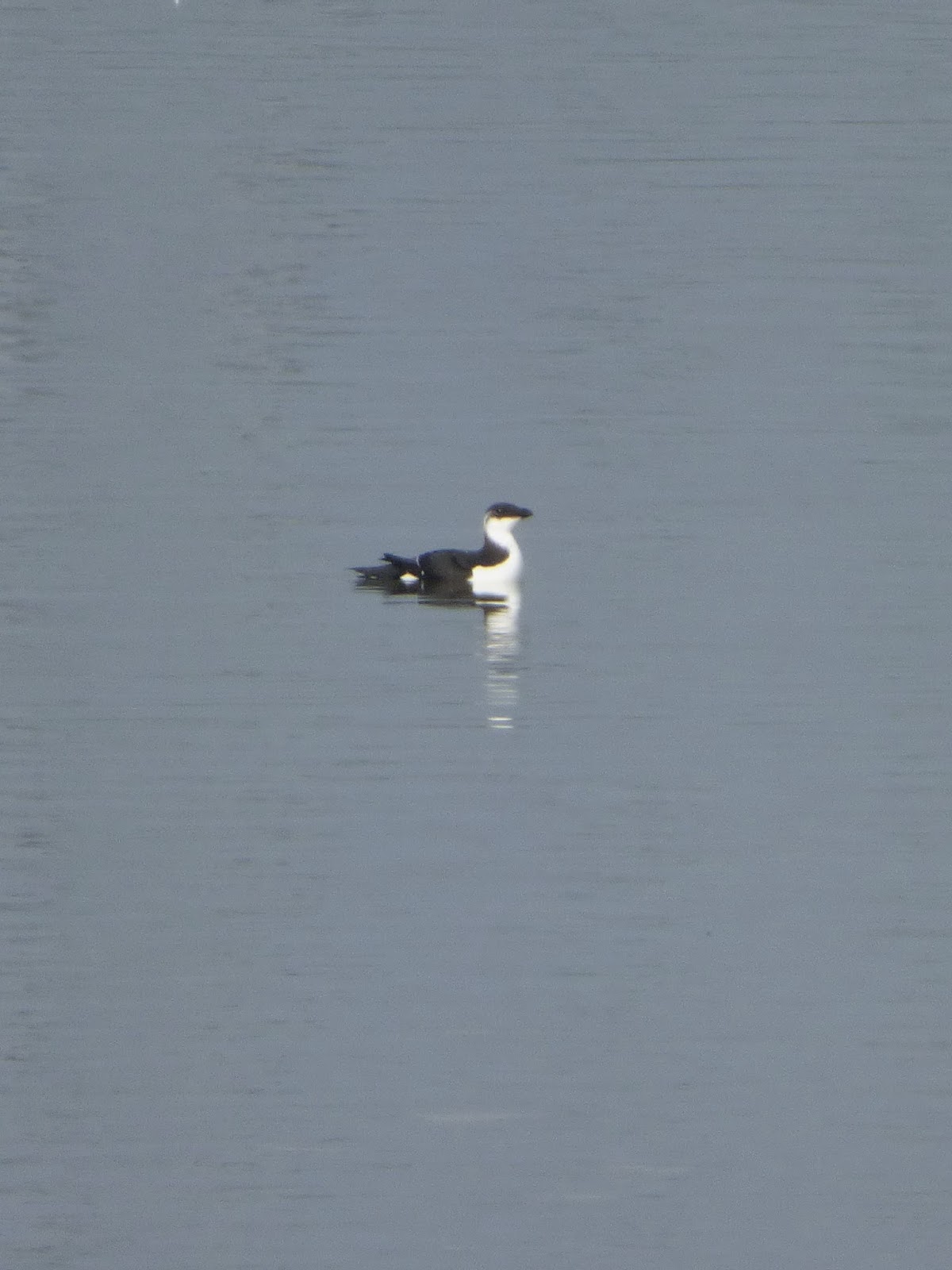
So I was blasé when I saw an auk doing the same today. Reviewing shots it looks like I fumbled a first-winter Razorbill-- which is a patch first.

Please accept my dodgy photo as penance for not being at all razor-sharp.

Aside from this rather passive auk movement, there was a little bit of visible migration this morning with an eastbound Rock Pipit the pick of the lot, and a creditable 10 Grey Wagtails. A similar number of alba wags went SE as did 5 Skylarks. Meadow Pipit vis. scarcely registered, with a mere 30 or 40.

More dramatic were the first skeins of Pink-footed Goose, with 50+20 N and 26 south, and the attractive circumzenithal arc pictured above.

Songbirds on the deck included 2 Stonechats, 5 Song Thrushes, 17 Chiffchaffs and 8 Goldcrests.

Wader interest included a Greenshank, a late-ish Common Sandpiper, 48 Golden Plovers and a Green Sandpiper.


DH.

Friday, 19 September 2014

Quiet Patch

Jon here.
I've had a busy few weeks and opportunities for birding Aldcliffe have been scarce, to say the least. Thanks as ever to Dan for covering the patch so diligently and for regularly updating the blog!

Last week I was on Jersey, visiting my brother Paul. I didn't get much time for birding but of course I had my bins with me wherever I went on the island.
I stumbled across plenty of common migrants including several spotted flycatchers, reed warblers, blackcaps and such, plus regular marsh harriers and the occasional hobby. Highlights included great white egret, cetti's warbler and black-necked grebe at St Ouen's Pond while a couple of birds I quite fancied running into totally eluded me. These were Dartford warbler, which unlike good Victorian children were heard but not seen, and short-toed treecreeper, which despite being a common resident proved otherwise during my visit.

Yesterday, I actually found a couple of hours to get down to Aldcliffe and have a good kick around. It seemed pretty quiet on the whole, though I suspect my arrival around 9am meant that I'd missed the best window of activity.
Freeman's Pools were hosting an impressive 10 little grebes, though not much else bar a trio of tufted duck and the usual other bits and pieces (plus a dead juv great black-backed gull on the island). A small increase in common teal numbers was evident but still no sign of any garganey - are we going to have a totally blank year?
7 wigeon were on Frog Pond along with the expected mallard & teal.
The maize fields continue to attract good numbers of chaffinch and reed bunting plus a single goldcrest was in the hawthorn hedge there.

A small number of chiffchaff were evident throughout the area but on the whole common migrants were very thin on the ground. The only other warbler seen was a lesser whitethroat by the Flood.
At the Wildfowlers' Pools a single green sandpiper was still in residence. Another pair of little grebe were also here as was a kingfisher and couple of snipe.
Out on the estuary a group of c40 golden plover were mixed in with the roosting lapwing on Gull Bank. There was nothing of note among the throng of black-headed gulls along the river, just the usual dozen or so little egrets.
A greenshank was feeding on the Lune by Cadaver Corner and another kingfisher was also seen here.
Good numbers of swallows were on the move throughout the morning; the only other 'vis' included small numbers of meadow pipit (compared with the huge movements a short distance away at Heysham & Sunderland Point), 2 skylarks and 7 grey wagtails.
Butterflies were out in force including the comma pictured here and dragonflies included common darter and migrant hawker (also pictured).