Friday, 30 May 2014

Week Finish


Dan here, with the main points of interest from a few visits this week.

The south, east and north of our isles seemed to be groaning with scarce migrants this week but if the NW of England was, nobody was finding them---myself included.

Never mind. Vis-mig-wise I mustered two late Sand Martins heading N, and a slightly unseasonal northbound Lesser Redpoll.

A count of 22 House Martins feeding over Freeman's Pools in showery weather was a good one, perhaps thanks to an increase in numbers using eaves in the Willow Lane area this year.

A pair of Arctic Terns has been noted daily, elegantly flapping round the estuary as far up as Marsh Point, and also getting cosy in the thriftier parts of Colloway Marsh south. I imagine rising water levels will scupper any hopes of a tern colony ever re-establishing itself there. Any wealthy conservationist/engineers fancy designing and helicoptering in some concrete nest platforms?

I watched a pair of Peregrines hunt down, kill and eat a Woodpigeon on the low tide mud near Gull Bank. The female was wearing the trousers and ate the majority while the male looked on. It's the first Peregrine sighting I've had here since mid-March.

Young birds are very much in evidence throughout, including five Goosander ducklings (down from 7 on May 13th) in the company of their mother. Recently-fledged birds ranging in size from Grey Herons to Chiffchaffs and Blue Tits are out and about, and flocks of post-breeding Starlings (circa two-thirds juveniles) have been numbering up to 300. Lapwings seem to be faring a little better than last year, with several full-size juvs seen, and two or three adults on eggs. No pitter-patter of LRP chick feet heard yet.

A pair of Grey Partridges looked rather exposed (and dare I say it- forlorn?) in a recently-harvested silage field and I feared that they might have lost a clutch to the machines.

An incubating Oystercatcher was highly agitated by a thoughtless traipser exercising her dogs way out on the thrift-covered saltmarsh. The irony is that at least half of the legion of marsh-wanderers will be animal and nature-lovers, who I picture tuning into BBC Springwatch (increasingly beyond parody!) and weeping at the sight of a Weasel chobbling a Dunnock brood...or something.

The old wildfowlers sign stating 'conservation area-- please keep to the footpath' has recently been re-painted but for many Aldcliffe users, ignorance is bliss.

Black-headed Gull numbers have been building recently with up to 150 adults per visit. I would guess that they are failed breeders taking an early bath.

In large wildfowl news, c100 Greylags have been feeding in and around Heaton Marsh, and the Aussie abomination (Black Swan) is still using Colloway Marsh north.

In one of the few warm spells this week, I noted c30 Common Blue Damselflies (with several pairs in tandem) at Darter Pool, and c15 Common plus 3 Blue-tailed damsels at the shallow pond by the eastern viewing area of Freeman's Pools.


DH.

Monday, 26 May 2014

The Aldcliffe Broads


Dan here.

The patch was bank holiday busy this afternoon, and instead of fretting about the next big bird I took it relatively easy and enjoyed the fair weather (a bit like normal people might).

My new camera seemed to enjoy the diffuse brightness too and I like this shot of a male Common Whitethroat taken near Freeman's Wood. Four were noted, and also four Lesser Whitethroats.

Chiffchaffs were of course very early this year so the first four fledged young shouldn't have been so much of a surprise. Other hedgerow bambinos included Long-tailed Tits and Greenfinches.

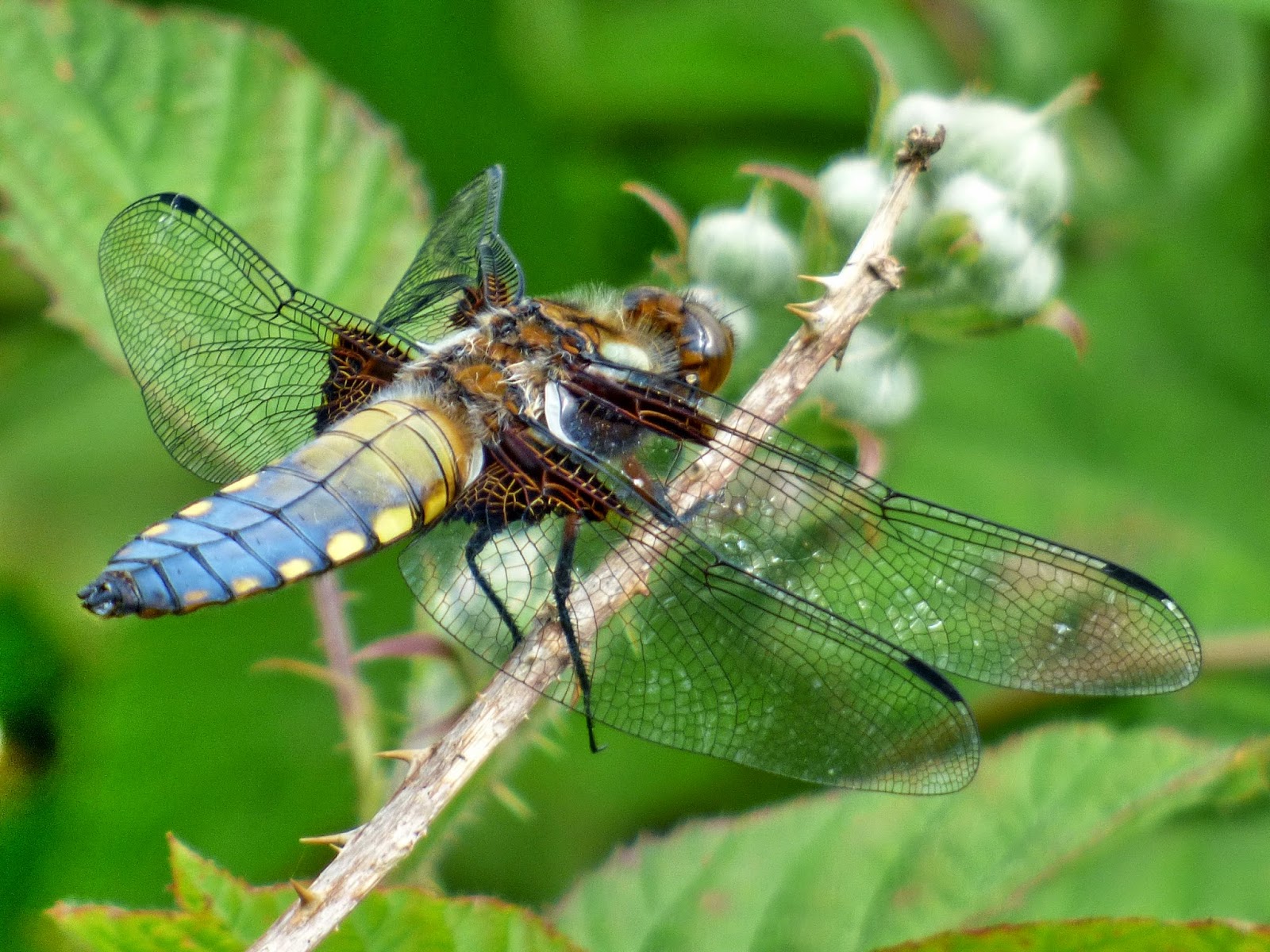
Bird of the afternoon was for sure the Broad-bodied Chaser pictured above. Although common elsewhere, this is only my 3rd or 4th patch record, and the first away from Freeman's Pools.
This male was at Stodday picnic site. It was perhaps an off-passage migrant, being some way from still freshwater, unless the sewage works tanks fall into their suitable habitat category.

Particularly after yesterday's martinfest, the parish was remarkably hirundine-free during my visit, with just two Swallows seen as they fed over the saltmarsh.

DH.

Sunday, 25 May 2014

Wake of the Flood

Hello. Dan here.

This evening I returned to the parish in the kind of rainstorms that would have had Noah phoning out for more supplies.

As the deluges subsided I had a brief look around and to my surprise dozens of Swallows were nattering in the hedgerows. Some were emerging from deep in the foliage and heading off, while others were drying out on more exposed perches as pictured below.

Whether they were passage migrants driven into the nearest cover, or local-ish breeders feeding at Aldcliffe thinking the rains had set in for good and were bedding down, I'm not sure. However, I've not seen spring roosts of this species here before, and a few minutes later they were dispersing (with three or four Sand Martins in the mix too). No House Martins were noted.

At least twenty Swifts were hawking over the patch as dusk began to fall. I checked the pools (old and new) but what few waders I saw were on territory. A rainbow showed up to the south east and Song Thrushes, Blackbirds, Chiffchaffs and Dunnocks began to sing.

Steve Ryder of the Lancashire Wildlife Trust (which manages Freeman's Pools) e-mailed me to say that two Avocets were present there a couple of days ago.


DH.

Monday, 19 May 2014

One Hundred Swallows do not a Summer Make


Dan here with a quick report of my afternoon visit to the parish.

Swallow passage was the dominant theme, with up to 100 per hour noted migrating ENE into a stiff breeze. Associated with this movement were 3 each of Sand and House Martin.

Best passerine was a rather tardy male Garden Warbler which was singing quietly in a hawthorn near Stodday before a brutish Blue Tit chased it away.

A short distance away were a number of fledgling Long-tailed Tits, presumably having recently emerged from the nest built by Chromedome (the pale-headed individual) back in March.

Other fledged young noted included Blackbird, Greenfinch and Robin as many martins, yet to reach their breeding sites passed overhead.

As with other birders, I was hoping that the late afternoon thunderstorms would drop stints and marsh terns on my head-- but I had to make do with raindrops instead. I spied two Whimbrels and 75 non-breeding plumage Bar-tailed Godwits on the estuary at Stodday, but I suspect the latter flock had only travelled a mile or two from Glasson.

Twelve Eiders were noted and two LRPs were at the Wildfowlers Pools.

The flood was devoid of birds, and the field was chock-a-block with sheep-- with around a thousand animals bleating away.

Freeman's Pools were not graced by Temmincks, but rather plagued by tykes. Eight youths climbed the reserve fences to the consternation of Lapwings and Shelducks. Three of the kids braved a swim while their friends rolled jazz woodbines on the banks.

Off to Spain for a few days. Happy birding!

DH.

Tuesday, 13 May 2014

Acro Action

Blimey, what a difference! This morning's trundle around the parish was delightful; no blustery wind, not a hint of drizzle, it was pretty mild and the air was positively filled with the sound of singing birds.
There were at least 5 sedge warblers in song around Freeman's Pools with a further 2 along Dawson's Bank and another near Walled Meadow. Whitethroat were blasting out all over the place, and a couple of lesser whitethroat were still bothering to proclaim territory. Reed buntings too were in fine voice with at least 3 singing males on the patch. Swift numbers appear to have risen significantly and a couple of dozen birds were wheeling around over the marsh and the adjacent pools.
A lone wheatear was on Aldcliffe Marsh, near Marsh Point but the bird of the day was undoubtedly the showy and very vocal reed warbler at the imaginatively named Corner Pool. This hitherto often overlooked spot shall forever now be associated with last week's magnificent shrike but in the past it has hosted a few other decent birds including garganey, water rail and wood sandpiper. And with that area currently in HLS it may yet become even more productive in coming years.

Out on the estuary highlights included a whopping 26 eider (8 ducks, 18 drakes) and more than 120 mute swans - plus a splash of exotica in the form of the returning black swan.
A female sawbill with a brood on her back had me excited briefly. Up to 3 red-breasted mergansers have been hanging around here lately and thoughts of successful breeding on this stretch of Lune had me rather giddy. However, a quick scan through my binocs soon confirmed that it was a goosander with 7 hitchhiking ducklings.     
A single whimbrel was near Cadaver Corner and little ringed plovers were in situ at the Wildfowlers' Pools and another nearby location.

Jon